NCD
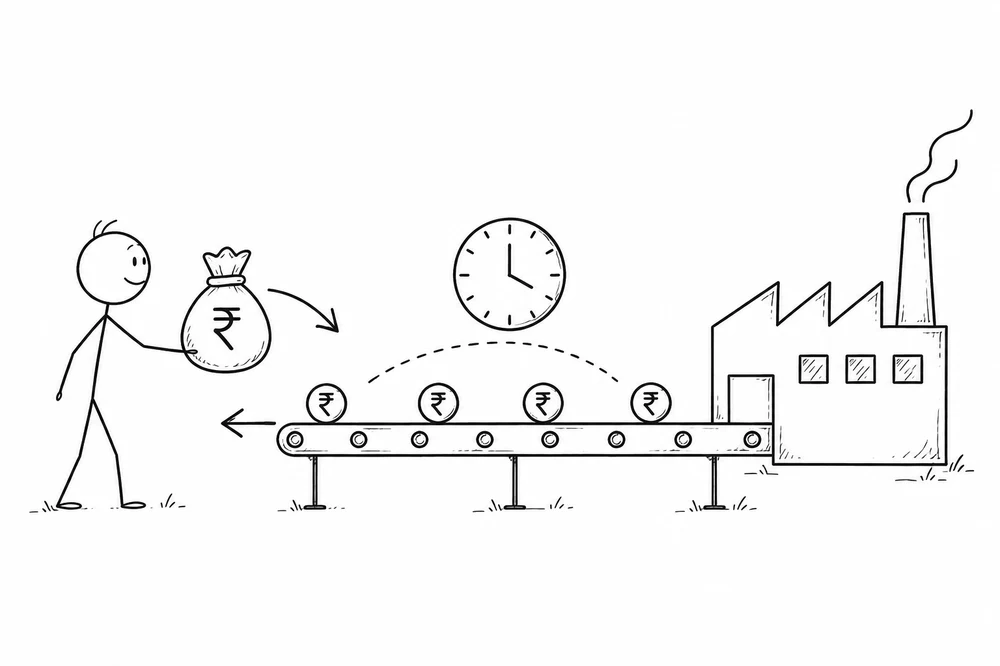
An NCD is you lending money to a company at a fixed rate for a fixed period. The “non-convertible” part is the whole personality of the instrument: this loan will never turn into shares.
Why companies issue them
A company that wants to borrow has three doors: a bank loan, a private placement to institutions, or a public NCD issue open to retail investors like you.

Secured, unsecured, and the rating alphabet
A secured NCD pledges specific assets against the borrowing; if the company fails, you stand ahead of unsecured lenders in the recovery queue.
The tax nobody mentions in the ad
The coupon is taxed at your slab rate, like FD interest. At the 30% slab, a 9% NCD pays you 6.3% in hand.
Where NCDs fit
I think of an NCD as a salary for money that already has a job. It belongs in the income sleeve of a portfolio, in size small enough that one default is an irritation, spread across issuers you have actually read about.
An NCD is you lending money to a company at a fixed rate for a fixed period. The “non-convertible” part is the whole personality of the instrument: this loan will never turn into shares. You will get interest in cash and your principal back in cash, on dates fixed the day the bond is issued. If you want the upside of the company, buy its shares. An NCD is for when you want to be its lender, and lenders get paid first and cheered last.
Why companies issue them
A company that wants to borrow has three doors: a bank loan, a private placement to institutions, or a public NCD issue open to retail investors like you. The third door is the one you see advertised, usually by NBFCs and housing finance companies, because their entire business is borrowing at one rate and lending at another. When you buy their NCD, you are funding a slice of their loan book. In September 2026, decent A-to-AA-rated NBFC paper was paying roughly 8.5-9.5%, against about 6.5-7% for a bank FD.
Secured, unsecured, and the rating alphabet
A secured NCD pledges specific assets against the borrowing; if the company fails, you stand ahead of unsecured lenders in the recovery queue. An unsecured NCD offers no such claim and pays a bit more for that reason. Neither word means “safe”. Security is a queue position, and the queue only gets paid if the assets are worth something when sold, which, in every Indian credit blow-up from IL&FS to DHFL, they mostly were not.
The credit rating, AAA down to D, is an agency’s opinion on default probability. Treat it as a starting filter, not a verdict: IL&FS carried AAA weeks before it defaulted. I would rather lend to a boring AA company whose business I understand than an AAA structure I cannot parse.
The tax nobody mentions in the ad
The coupon is taxed at your slab rate, like FD interest. At the 30% slab, a 9% NCD pays you 6.3% in hand. If you sell the bond on the exchange before maturity, the gain or loss is a capital gain, and the price you get depends on where interest rates and the issuer’s reputation stand that day. The headline rate in the advertisement assumes you hold to maturity and the company pays on time; both are assumptions, one of them yours to keep.
Where NCDs fit
I think of an NCD as a salary for money that already has a job. It belongs in the income sleeve of a portfolio, in size small enough that one default is an irritation, spread across issuers you have actually read about. If you are weighing one against a fixed deposit, the fuller comparison is in my NCD vs FD piece.
A company borrowing from thousands of strangers is making a promise it keeps out of reputation, not affection. Price the promise, read the fine print about what stands behind it, and never confuse the adjective “secured” with the noun “safety”.