UPI economics
Every debate about UPI starts with the same question: why is the government spending money to keep it free? That question now needs a correction.
What is still free, and what is not?
Ordinary person-to-person UPI payments remain free, whatever the amount. Customers paying a merchant also continue to pay only the purchase price.
What does it cost to run UPI?
NPCI’s FY 2024–25 numbers caught my attention. It made roughly ₹4,000 crore in revenue and about ₹1,500 crore in profit.
Then why do banks and apps complain?
Because scale and profit are different things. A payment app can process billions of transactions and still struggle to make money from them.
Who pays for free UPI?
Banks and payment apps absorb some of it. NPCI earns revenue from the wider payments system. The government supports eligible low-value merchant transactions through an incentive scheme.
The exceptions started before this
Wallet-funded UPI was already different. Since April 2023, merchant payments above ₹2,000 made from prepaid wallets can carry interchange of up to 1.1%.

Should UPI have MDR?
This is where the debate becomes harder. A limited MDR now gives banks and apps a direct revenue model on some larger merchant payments.
Every debate about UPI starts with the same question: why is the government spending money to keep it free?
That question now needs a correction. UPI is still free for people sending money, and customers are not meant to pay a transaction fee. But from 15 October 2026, some larger merchant payments will carry MDR inside the merchant-payment system.
I think that is the wrong question.
The better question is: what would India have spent without UPI?
Cash does not move for free. Between FY22 and FY25, the RBI spent roughly ₹21,000 crore just printing banknotes. That does not include ATMs, cash vans, vaults, security, branch handling, or the cost of sorting and destroying soiled notes.
Over the same period, UPI carried about ₹670 lakh crore of payments, much of it small-ticket activity that would otherwise have stayed in cash. The government’s roughly ₹8,000 crore of incentives for RuPay debit cards and low-value UPI payments looks very different beside that avoided cash bill.
Card payments also need terminals and merchant fees. A cheque can spend a day travelling through a system before the money moves.
UPI hides most of this work behind one scan.
What is still free, and what is not?
Ordinary person-to-person UPI payments remain free, whatever the amount. Customers paying a merchant also continue to pay only the purchase price. Apps cannot add a UPI platform fee, and merchants are not allowed to pass MDR on to the customer.
On the merchant side, the line is now more specific:
- Merchant payments up to ₹2,000 remain at zero MDR.
- Small merchants receiving up to ₹1 lakh a month through UPI QR codes remain at zero MDR.
- From 15 October 2026, other eligible merchant payments above ₹2,000 carry 0.4% MDR. The charge is capped at ₹300 for payments of ₹75,000 or more.
- Railways, telecom, insurance, fuel, utilities and some other essential sectors pay a flat ₹5 above ₹2,000.
- Capital-market payments carry 0.02% MDR, capped at ₹300.
So UPI is still free for the person making the payment. It is no longer free for every merchant receiving one.
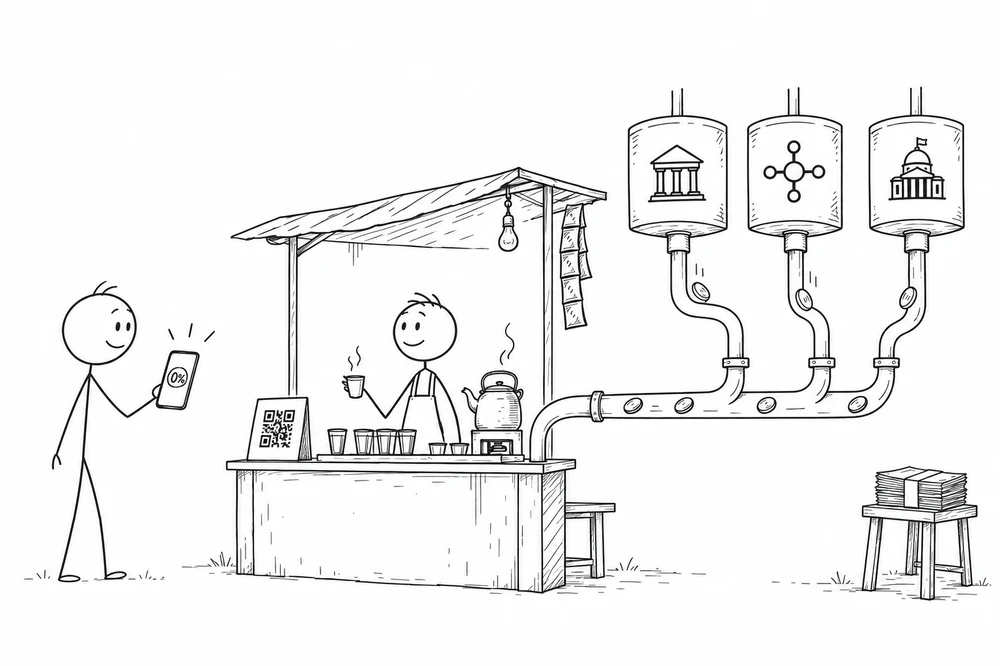
Four sets of players do the work:
- NPCI runs the central switching infrastructure.
- Banks maintain accounts, process requests and deal with failed transactions and fraud.
- Apps such as PhonePe, Google Pay, Paytm and bank apps bring users into the system.
- The government still supports covered transactions, while MDR now applies to a narrow set of larger merchant payments.
The bill exists. It is simply not shown to the customer at checkout.
What does it cost to run UPI?
NPCI’s FY 2024–25 numbers caught my attention. It made roughly ₹4,000 crore in revenue and about ₹1,500 crore in profit. Its technology expense was around ₹210 crore, with another ₹290 crore of depreciation.
Taken together, that is about ₹500 crore for the technology and asset layer behind UPI, IMPS and NACH.
That number does not represent the entire cost of every UPI transaction. Banks and payment apps carry their own infrastructure, support, compliance and fraud costs. NPCI’s accounts cannot tell us what the whole ecosystem spends.
But they do tell us something useful: the central switch serving a country of India’s size is remarkably efficient.
Then why do banks and apps complain?
Because scale and profit are different things.
A payment app can process billions of transactions and still struggle to make money from them. Most UPI payments still produce no MDR. Apps can sell loans, insurance or other financial products, charge for devices and business services, or earn a share of MDR on the limited transactions that now carry it.
Banks face another problem. UPI can replace transactions that once earned them fees, while they still have to maintain the accounts and systems underneath.
So two statements can be true at once:
1. UPI is extraordinarily cheap compared with older payment rails.
2. The companies processing UPI still need a way to recover their costs.
Who pays for free UPI?
The cost is still split.
Banks and payment apps absorb some of it. NPCI earns revenue from the wider payments system. The government supports eligible low-value merchant transactions through an incentive scheme. Larger eligible merchants now contribute through MDR.
In other words, “free” UPI is a policy choice about who should pay, not proof that the system has no cost.
There is a fair argument for this choice. Payments infrastructure creates value outside the transaction itself. It formalises commerce, leaves a digital trail, reduces cash handling and gives small merchants access to tools that once needed a card machine.
A rupee spent on UPI cannot be judged only against zero. It should be judged against the cost of the system it replaces.
The exceptions started before this
Wallet-funded UPI was already different. Since April 2023, merchant payments above ₹2,000 made from prepaid wallets can carry interchange of up to 1.1%. That is an ecosystem charge, not a fee collected from the customer. Normal bank-account-to-bank-account UPI was not covered by it.
RuPay credit cards linked to UPI also run on separate merchant-fee rules. NPCI changed the app and payment-provider share of those fees in April 2026. The new 0.4% bank-account UPI framework does not replace the credit-card rules.
I could not find any verified bank charge on ordinary UPI users. The September 2026 rules say the opposite: person-to-person payments stay free, customers cannot be charged, and bank limits are risk controls rather than charging thresholds.
Should UPI have MDR?
This is where the debate becomes harder.
A limited MDR now gives banks and apps a direct revenue model on some larger merchant payments. The risk is pushing merchants back to cash, especially when every rupee of margin matters.
A flat rule would be blunt. A roadside tea stall and a large online merchant do not have the same ability to pay. Nor do a ₹50 payment and a ₹50,000 payment create the same economics.
I tried putting a number on the other side too. My first estimate put annual UPI MDR near ₹10,000 crore across loan collections, everyday spending, retail and other categories. One assumption on loan repayments was wrong: those charges are capped at ₹5. Correcting it brought the estimate closer to ₹6,000 crore.
The exact number will move with the assumptions. A universal MDR is not a small switch. It can move thousands of crores between users, merchants, banks and payment apps.
The useful question is not “free or paid?” It is “which transaction should be subsidised, which merchant can bear a fee, and what behaviour are we trying to encourage?”
UPI won because it made the payment disappear. The next phase is making its economics visible without putting friction back into the scan.
Author’s note: This article brings together my 22 September 2025 post on NPCI’s costs, 10 June 2026 post comparing UPI incentives with cash-printing costs, 15 September 2026 follow-up on those savings, 15 September 2026 estimate of annual UPI MDR, and my 16 September 2026 correction to that estimate.